Anonymized · prop trading firm
Real-time position reconciliation service
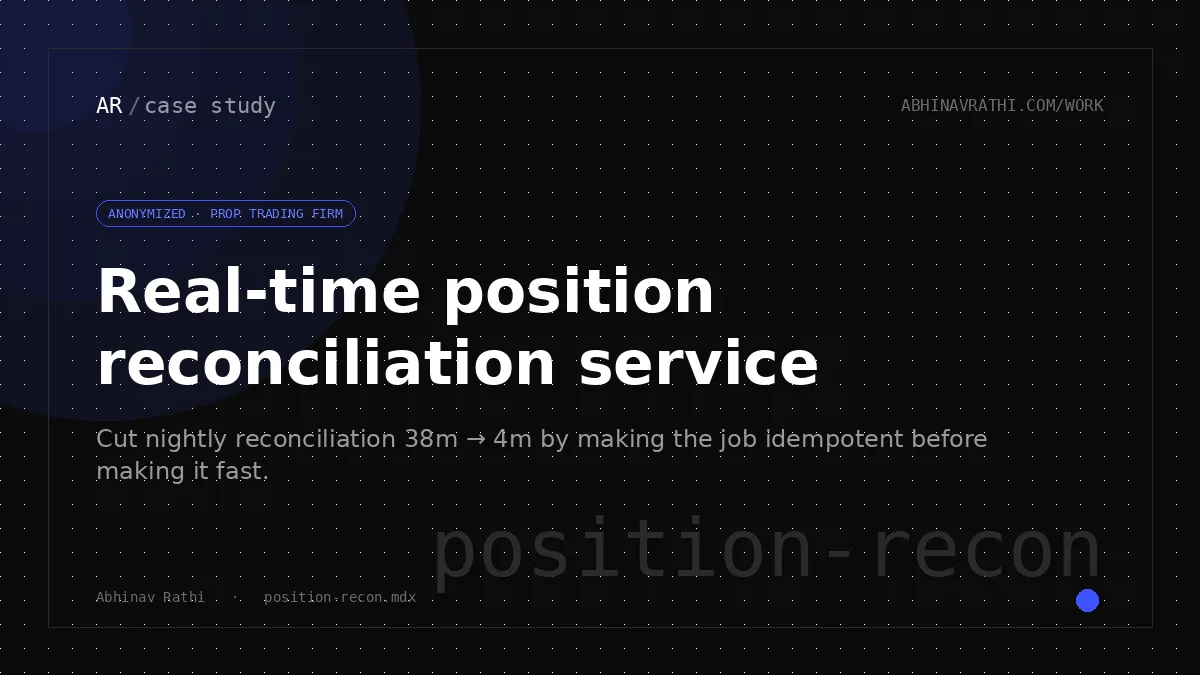
Cut nightly reconciliation 38m → 4m by making the job idempotent before making it fast.
- Role
- Owner · backend
- Year
- 2026
- Read
- 2 min read
- nightly runtime 38m → 4m
- duplicate fills (post-deploy) 0
- p99 service latency < 50ms
- DB connection pool used −70%
Outcome. Cut the nightly position-reconciliation runtime from ~38 min to ~4 min by replacing N+1 ORM access with bulk MySQL writes — but the win that mattered was making the job idempotent so it could be re-run safely under retries, with zero duplicate fills since deploy.
Context
End of every trading day, the firm’s position state has to reconcile against external broker statements. The existing job ran ~38 min and would silently double-write on retry. Both are bad in different ways: minutes of lag at the wrong moment of the day, and duplicate fills mean corrupted state somebody hand-cleans the next morning before the desk can trade. The unit of work, when wrong, is dollars.
My role
Owner. Schema design, service implementation, deploy, post-incident review. Reviewed by a senior engineer; shipped solo behind a feature flag.
Approach
The first instinct was the obvious one — index harder. Helped ~20%, didn’t fix it. The actual constraint was N+1: each row update was its own write, and a batch of millions of fills meant millions of round-trips.
I tried two things that didn’t work before the one that did. First, I bumped the DB pool size — fine in staging, broke in prod the moment two batches overlapped. Second, I tried vertical-partitioning the positions table; that swapped one lock-contention pattern for another. Neither shipped.
What worked was two changes that landed together:
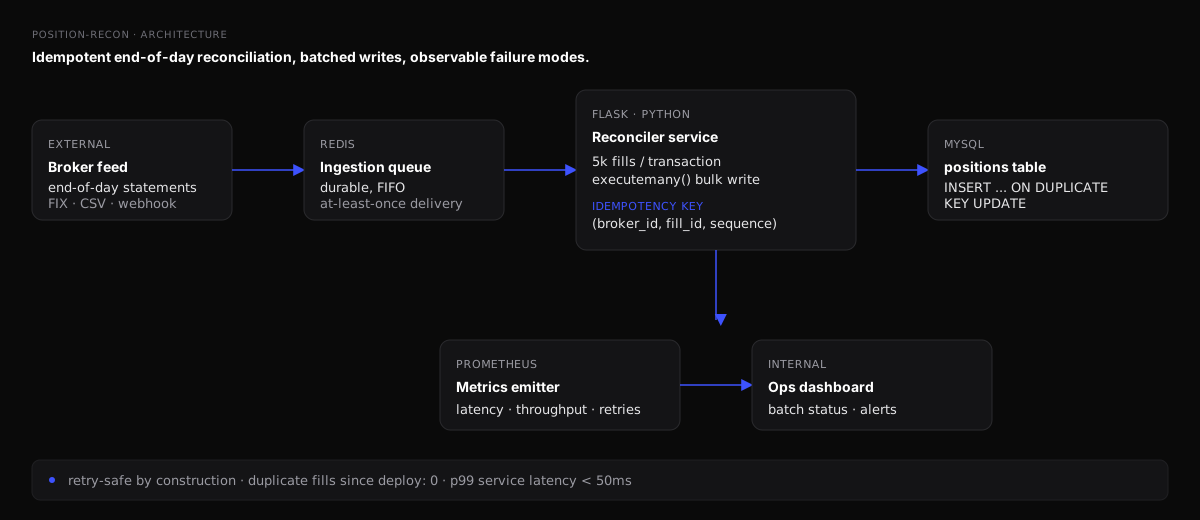
- Bulk writes. Batches of 5k rows via
executemanyinside a single transaction. The first ~95% of the speed-up came from the round-trip collapse, not from the engine. - Idempotency keys. A composite of
(broker_id, fill_id, sequence)enforced at insert time viaINSERT ... ON DUPLICATE KEY UPDATE. A retry no longer doubles the position; it short-circuits.
The second change matters more than the first. The visible win is the runtime; the load-bearing win is that the job is now re-runnable. Once a job is safe to re-run, you can be aggressive about cutting batch sizes without the fear that used to be the whole reason for the long runtime.
Architecture
Results
- Nightly runtime 38 min → 4 min.
- Duplicate fills since deploy: 0 (rolling 90-day window).
- Service-call p99 < 50ms under steady-state load.
- DB connection-pool utilization down ~70%.
- Next-morning hand-cleanup time eliminated: ~1 hr/day (~65 hrs/quarter).
What I’d do differently
I’d have written the idempotency contract in v0, before any optimization work. The 8× speed-up was the visible result, but the real value was that the job became safe — and I retrofitted that, which meant a deploy gap where I had a fast but unsafe job in staging. Next time, idempotent boundaries get designed in before the perf measurements.
- Python
- Flask
- MySQL
- Redis
- Docker