RespiScan 2.0
Wrapped a hackathon ML model in a real service — the engineering value is the loop around the model, not the model.
- Role
- Lead · ML + service
- Year
- 2024
- Read
- 1 min read
- Repo
- GitHub →
- validation AUC 0.92–0.94
- p95 inference latency 50–100ms
- team 2 engineers
Outcome. Took the original RespiScan from “notebook that runs” to “service a clinician can click through”. Same model; the engineering value is the loop around the model, not the model.
Context
The original RespiScan was a notebook — train, eval, predict, all inside one Jupyter file. RespiScan 2.0 wraps the same model in a small Flask service with an explicit eval pipeline and a UI, because the gap between “notebook works” and “useful” is mostly tooling.
My role
Lead, two-person team. I owned the inference service, the eval harness, and the frontend. My teammate owned the data prep and model tuning.
Approach
The first version of the inference service was the obvious one: a single
Flask route that calls model.predict() per request. Worked in benchmarks,
fell apart under any load — Intel oneAPI’s runtime had warm-up cost that
made tail latency wildly variable. First request: hundreds of ms.
Twentieth request: seconds, sometimes.
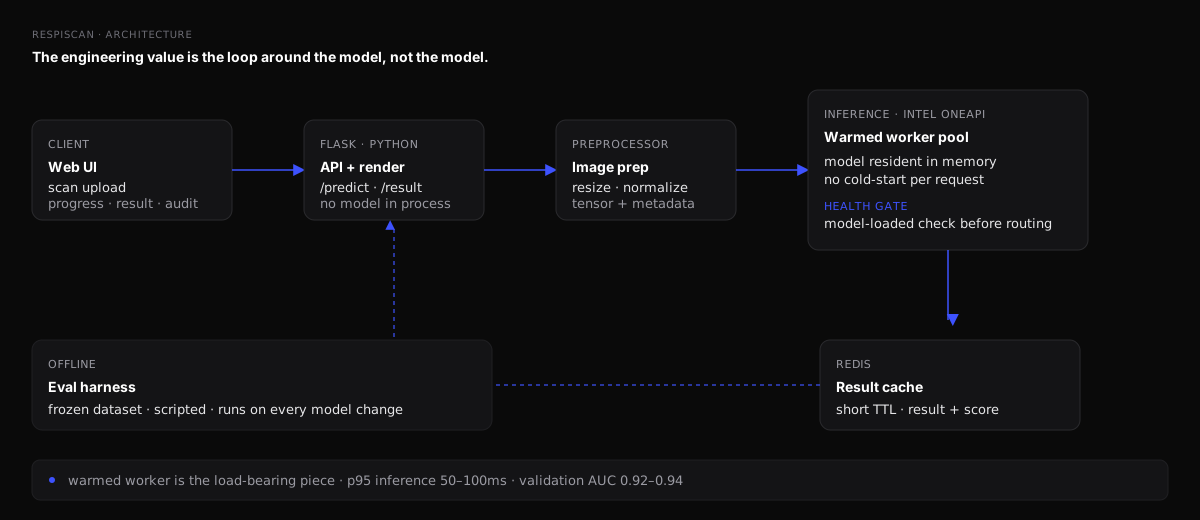
What worked was a warmed worker process behind the Flask layer, with a health check that confirms the model is actually loaded and responsive before traffic gets routed to it. p95 collapsed from “occasionally seconds” to tens of ms and stayed there.
The model itself is a CNN over preprocessed scan inputs. Less interesting than the service shape — most of the engineering value is in the eval harness (reproducible, scripted, runs on every change) and the warmed worker layer (keeps the inference predictable).
Architecture
Results
- Validation AUC: 0.92–0.94 (reproducible from the eval harness).
- p95 inference latency after the warmed-worker change: 50–100ms.
- End-to-end (image upload → result on screen): p95 < 1s.
What I’d do differently
I’d have written the eval harness first, before the model. It’s the only honest way to know if a tweak helps. We had two false-positive “the model is better now” moments that turned out to be eval drift, not real gains.
- Python
- TensorFlow
- Flask
- Intel oneAPI