Anonymized · prop trading firm
Order & trade ingestion pipeline
One pipeline for N broker feeds. Pluggable adapters, single canonical schema, recovery-first design.
- Role
- Owner · backend
- Year
- 2025
- Read
- 2 min read
- brokers integrated 4–5
- time to add a new broker weeks → days
- lost confirmations during broker outages 0
- lines of glue code retired ~3,000+
Outcome. Replaced an N×M tangle of per-broker integration scripts with one Flask + MySQL ingestion service that ingests confirmations from every broker, normalizes to a single canonical schema, and survives partial outages without losing fills.
Context
Trade confirmations arrive from multiple brokers in different shapes — mostly FIX, occasionally CSV drops, occasionally a webhook with its own quirks. Downstream services don’t care about that variety; they want one canonical schema. The previous integration was a hand-stitched pile of broker-specific scripts, and every new broker meant two weeks of glue code plus a new thing for ops to monitor.
My role
Owner. Designed the abstraction, shipped the pipeline, migrated the existing brokers off the old scripts over four sprints.
Approach
The first design was “one ingester service per broker” — clean code, linear scaling, but operationally awful: N services to monitor, N deploy pipelines, N sets of credentials. I shipped one prototype that way, then threw it out.
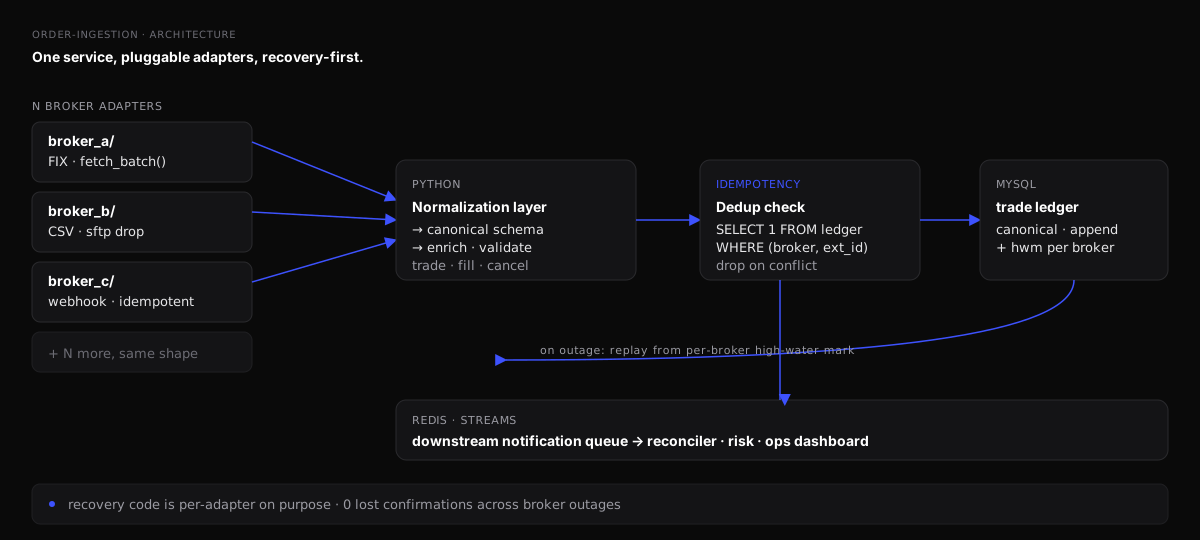
The second design was the one that stuck: one ingestion service,
plug-in adapters per broker, a single canonical normalization step
in the middle, single persistence layer at the end. Each adapter is a
small interface (fetch_batch, parse, high_water_mark) in its own
module; testing per-broker became actually possible because the boundary
was real, not implied.
The hard part wasn’t the normalization. It was idempotency under partial outages. A broker disconnects mid-batch, you reconnect, do you replay from your high-water mark or from theirs? Different brokers answer this differently. What worked was per-broker high-water-mark tables and a recovery routine that’s specific per adapter — explicit code is better than clever code when the cost of being wrong is a missed fill.
Most of the bugs in the first three months were recovery edge cases, not happy-path bugs. The lesson was load-bearing for the next project.
Architecture
Results
- Brokers integrated: 4–5, all on a single service.
- Time to onboard a new broker: weeks → days.
- Confirmations dropped during broker outages over the year: 0.
- Old per-broker glue scripts retired: ~3,000+ lines.
- p99 confirmation-to-DB latency: < 100ms.
What I’d do differently
I’d start with the recovery routine, not the happy path. Shipping the “normal case” first felt productive but the bugs that mattered were all in the recovery code, and those landed weeks later under real outages.
- Python
- Flask
- MySQL
- Redis
- Docker